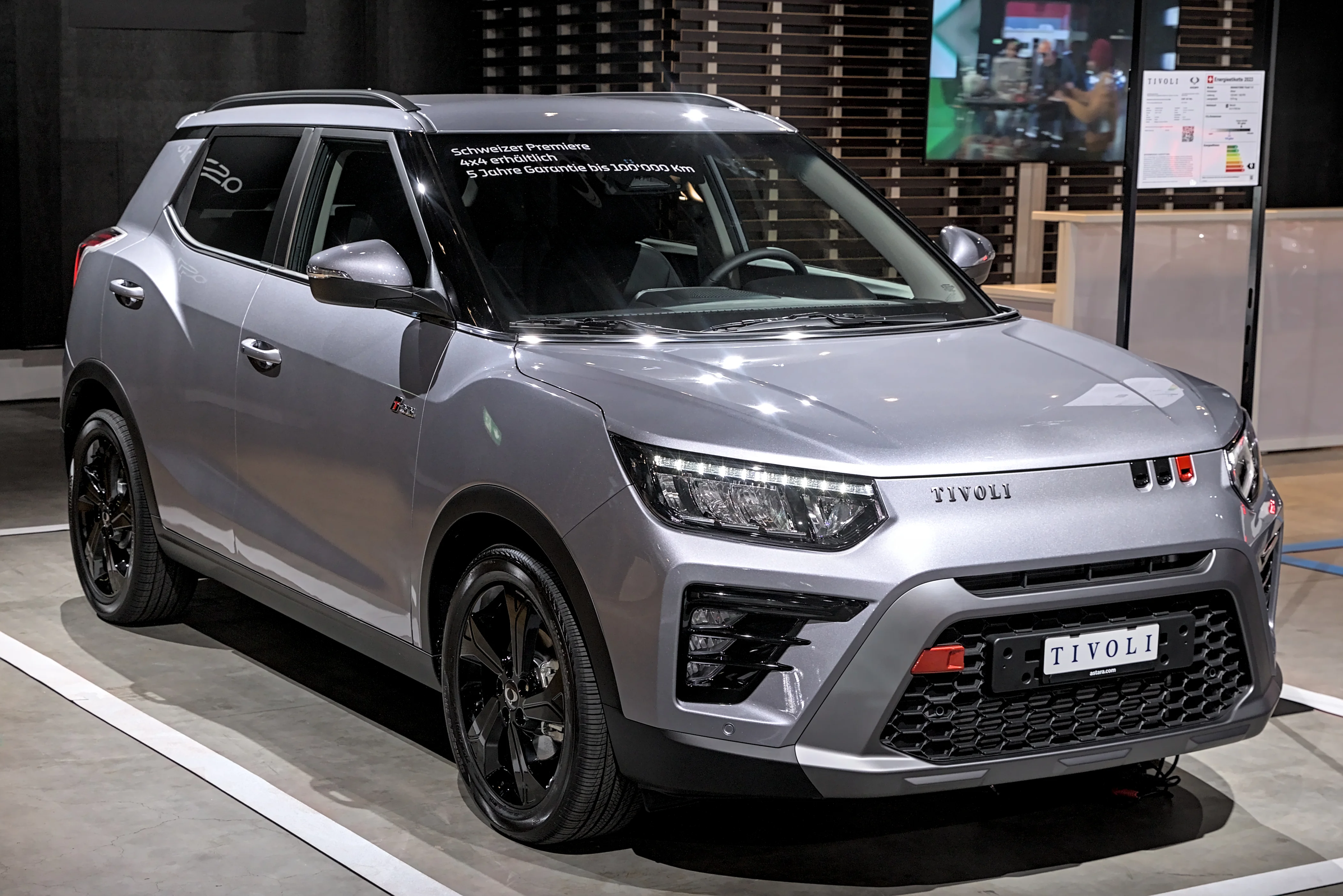
1.2 L e-XGi120T T-GDI I3 (petrol)
1.5 L e-XGi150T T-GDI I4 (petrol)
1.6 L e-XGi160 I4 (petrol)
1.6 L e-XDi160 I4-T (diesel)
Transmission
6-speed manual
6-speed Aisin automatic
Wheelbase
2600 mm (102.4 in)
Length
4195 mm (165.2 in) (pre-facelift)
4225 mm (166.3 in) (facelift)
4440 mm (174.8 in) (XLV)
Width
1795 mm (70.7 in) (pre-facelift)
1810 mm (71.3 in) (facelift)
1798 mm (70.8 in) (XLV)
Height
1590 mm (62.6 in) (pre-facelift)
1613 mm (63.5 in) (facelift)
1605 mm (63.2 in) (XLV)
Weight
1300 kg (2,866 lb) (petrol)
1390 kg (3,064 lb) (diesel)
1425 kg (3,142 lb) (XLV FWD)
1535 kg (3,384 lb) (XLV AWD)
Assembly
Pyeongtaek, Gyeonggi Province, South Korea (SsangYong Motor Company)
Saveh, Iran (Noora Motor Pars)
Chakan, Maharashtra, India (Mahindra), (for Sri Lanka) (2015-2020)
No reviews yet. Be the first to share your experience.
Leave a Review
SsangYong — Brand Guide, History & Model Overview
Founded1954
FounderHa Dong-hwan
HeadquartersPyeongtaek, South Korea
CountrySouth Korea
Models listed10
About SsangYong
SsangYong (now KG Mobility) is a South Korean automaker founded in 1954, specialising in rugged, value-oriented SUVs and pickups.
On this page you will find the complete SsangYong model range with detailed technical data, dimensions, engine and transmission information, plus genuine owner reviews. Whether you are researching SsangYong specifications, comparing trims, or reading real-world SsangYong reviews before you buy, our catalogue currently lists 10 SsangYong models to explore.
History & Heritage
SsangYong was founded in 1954 by Ha Dong-hwan, and is headquartered in Pyeongtaek, South Korea. Over the decades the brand has grown from its early roots into a name recognised by drivers around the world, shaped by its engineering choices, design language and the people who build and drive its cars.
Understanding a manufacturer's heritage helps put its current cars in context. Each generation of SsangYong models reflects the priorities of its era, from mechanical layout and powertrain technology to safety systems and interior comfort. The specifications on this site let you trace how SsangYong vehicles have evolved in size, power and equipment over time.
Mission & Vision
Mission: To build capable, affordable SUVs for work and family life.
Vision: To grow as a global specialist in tough, practical vehicles.
The brand is often associated with its slogan, “Powered by Passion”, which captures the character it aims to deliver in every model.
These guiding principles influence everything from how SsangYong engineers its platforms to the way it prices and equips its cars, and they are a useful lens when weighing up a SsangYong against rival brands.
SsangYong Model Lineup
The current SsangYong catalogue on AutoSpecs includes the following models. Click any model to see its full specifications, dimensions and reviews:
From compact and city-friendly options to larger family and performance models, the SsangYong range offers a variety of body styles and powertrains. Use our comparison tool to place any two SsangYong models side by side, or compare a SsangYong against a completely different brand.
Design, Technology & Performance
SsangYong models are described on this site with the technical detail buyers care about: engine type and displacement, transmission, drivetrain layout, wheelbase, length, width, height and kerb weight. These figures are essential when you are judging performance potential, interior space, efficiency and everyday practicality.
Comparing SsangYong specifications across models makes it easy to see the trade-offs between a smaller, lighter car and a larger, more powerful one. Dimensions affect how a car parks, corners and carries passengers and luggage, while engine and transmission details hint at how it will feel to drive. Reading the numbers alongside real owner reviews gives a rounded picture before a test drive.
Buying & Ownership Guide
If you are shopping for a SsangYong, it pays to research thoroughly. Look at the SsangYong price for the trim you want, compare it with rivals, and check the specification sheet for the equipment that matters to you. Whether you are considering a new SsangYong or a used SsangYong, matching the model's dimensions and engine to your needs helps avoid buyer's remorse.
Owner reviews are one of the most valuable resources when buying a car. On each SsangYong model page you can read comments from real drivers and add your own experience, covering reliability, running costs, comfort and everyday usability. Together with the detailed spec tables, these reviews help you make a confident, well-informed decision.
Frequently Asked Questions
How many SsangYong models are listed on AutoSpecs?
We currently list 10 SsangYong models with full specifications, dimensions and owner reviews, including KGM Tivoli, KGM Torres, SsangYong Actyon.
When was SsangYong founded?
SsangYong was founded in 1954, and is headquartered in Pyeongtaek, South Korea.
Where is SsangYong from?
SsangYong is associated with South Korea and is based in Pyeongtaek, South Korea.
Where can I find SsangYong specifications and dimensions?
Every SsangYong model page on AutoSpecs includes a detailed specification table with engine, transmission, wheelbase, length, width, height and weight, so you can compare SsangYong specs quickly.
Can I compare SsangYong models with other cars?
Yes. Use our comparison tool to place two cars side by side. You can compare two SsangYong models, or compare a SsangYong against any other brand to see the differences in specs.
Leave a Review